My generation seeks courage and clarity. If Orlando charts a new course for the SBC, expect Gen Z to want to join in the mission
Last month, Southern Baptists gathered in Orlando for the annual meeting of the Southern Baptist Convention, the world’s largest annual parliamentary meeting for America’s largest Protestant denomination.
As a 25-year-old member of Generation Z who was saved, baptized, and discipled in the Southern Baptist Convention, I want to see the Convention remain faithful for the next generation.
Fortunately, I left Orlando more encouraged about the future of the Convention than I have been in years. It felt like the appetite for convictional clarity and courageous leadership necessary for Baptist renewal was beginning to emerge, and that is exactly the kind of renewal young Southern Baptists are hungry for.
Zoomer Baptists in the Convention want more than the status quo or vague appeals to the Great Commission. We want clarity in our convictions as a Convention and in our leaders, with the courage to carry them out.
Before I offer six specific reflections, let me briefly recap the two most important developments from the meeting.
Two Important Developments in the SBC
1. Willy Rice was elected SBC President
Southern Baptist Convention presidents serve a one-year term and may serve up to two consecutive years. Traditionally, presidents run unopposed in their second year.
This year, there were two presidential candidates.
The “insider” candidate was Joshua Powell, pastor of Taylors First Baptist Church in South Carolina and a longtime SBC institutional leader. Powell had served as president of the South Carolina Baptist Convention, chair of Southern Seminary’s trustees, and chair of North Greenville University’s board. Powell ran on a Great Commission-focused platform.
The “outsider” candidate was Willy Rice, senior pastor of Calvary Church in Clearwater, Florida, a congregation he has led for more than two decades. Rice is a former North American Mission Board trustee who has become a prominent voice for conservative reform within the denomination. The theme of Rice’s campaign was “Baptist Renewal,” centered around increased convictional clarity and greater transparency across the SBC’s various entities.
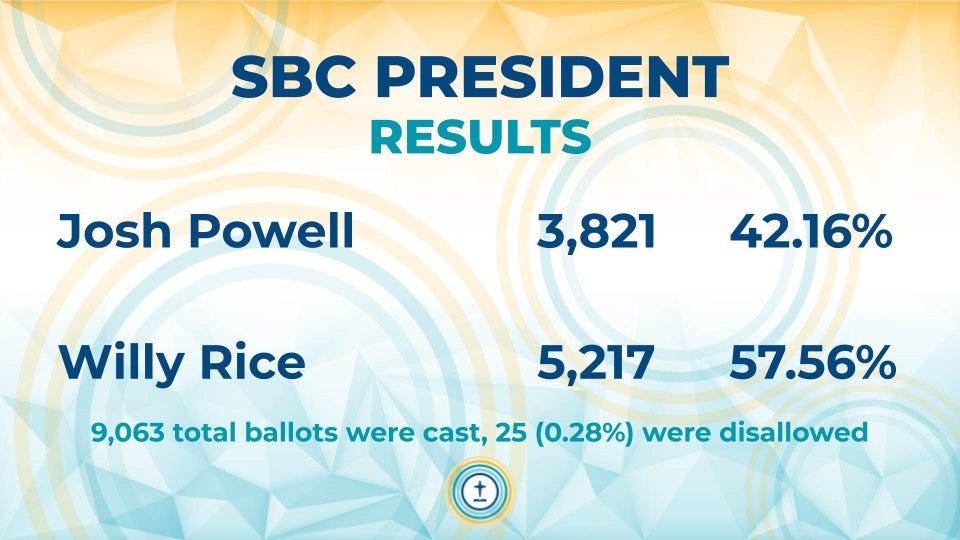
Willy Rice ultimately won the vote 58% to 42%. This marked the first time the “outsider” presidential candidate has won since the SBC began drifting in a big-tent and liberal direction about a decade ago.
The office of the SBC president matters because the president serves as the default spokesperson for the Southern Baptist Convention, which is the largest and most conservative Protestant denomination in the country. And, more importantly, entity leadership is downstream from presidential appointments, making the SBC presidency one of the most important levers for long-term institutional reform.
2. The Truth and Unity Amendment Passed (Year 1 of 2)
For the fourth year in a row, a constitutional amendment was proposed from the floor that would reserve the pastorate in the SBC to biblically qualified men.
This is already the adopted position of the Baptist Faith and Message 2000. However, the SBC Constitution, which lays out the rules for the convention, only requires churches to “closely identif[y] with” the BFM 2000.
This year, the amendment was put forward by Southern Seminary President Albert Mohler. The Truth and Unity constitutional amendment passed 75% to 25%.
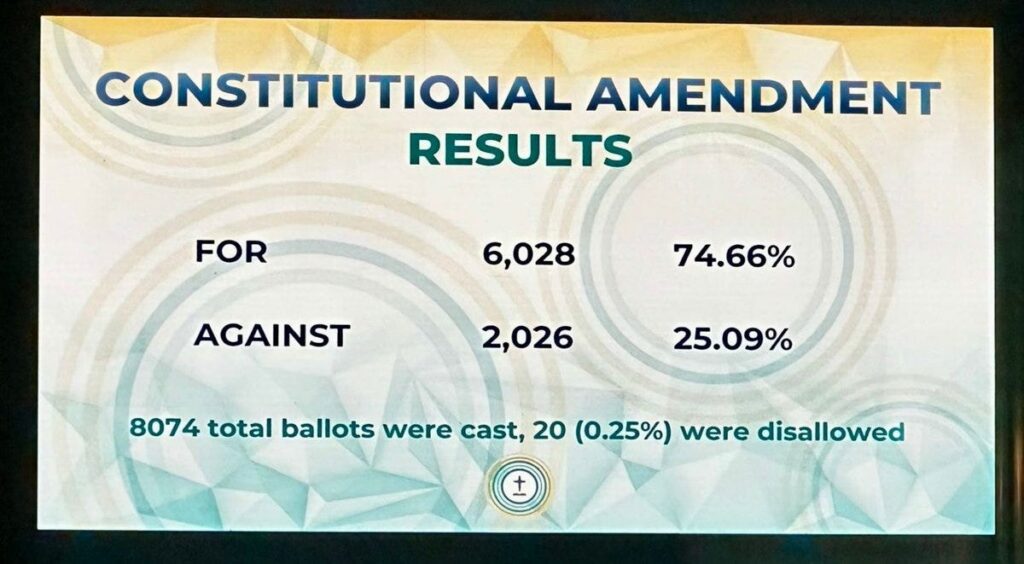
Mohler’s influence likely carried the Truth and Unity Amendment over the two-thirds threshold required for passage. But constitutional amendments must receive a supermajority vote in two consecutive years to pass. Notably, newly elected SBC President Willy Rice has promised to do everything he can to ensure it passes again next year.
Southern Baptists passionately disagree about many issues. But supporters of this constitutional amendment believe this issue is of primary importance because of its connection to scriptural inerrancy, a foundational belief of the Southern Baptist Convention.
In other words, since Scripture clearly reserves the pastorate for qualified men and since complementarianism is evident in the creation order, the belief that women may serve as pastors undermines a core Baptist conviction about the authority of Scripture.
Six Gen Z Reflections on SBC 2026
1. The “vibe shift” is officially underway in the SBC
We have seen a national political “vibe shift” with outsider Donald Trump coming into office, especially the second time around, when he won a non-consecutive second term and returned with policies and personnel ready to go.
With the election of Willy Rice, the first outsider candidate to win in the SBC’s post-COVID era, we may be witnessing a similar shift within the SBC.
Rice is not coming in as a generic caretaker or status quo president. He is coming in with a defined set of priorities, which he has been campaigning on since last October. That, combined with his stated desire to correct past mistakes, makes his candidacy unique and significant.
To be sure, there were several factors working in Rice’s favor this year. The convention was held in his home state, and he was scheduled to speak at the Pastors’ Conference before the annual meeting. Still, this vote may prove to be the spark that ignites a fire of genuine Baptist renewal.
2. A small, motivated group of Reformers can accomplish a lot together
The Center for Baptist Leadership launched in 2024, but by working with allied individuals and organizations, it has already contributed to significant changes within the SBC.
Here are some of the victories we have achieved over the past year:
- The ERLC cut ties with the problematic Evangelical Immigration Table
- ERLC President Brent Leatherwood stepped down as president after years of failing to faithfully represent the SBC in the public square
- An institutional heavyweight sympathetic to the reformers’ arguments has been elected SBC president
- The Truth and Unity Amendment was passed, which means we are one vote away from ratifying a constitutional amendment to reserve the pastorate to qualified men
If this is what a few dozen people dedicated to reform can accomplish, what could a few hundred accomplish?
Which leads me to my next point…
3. This is the perfect time to recruit more based Baptist Zoomers
Zoomers have the time, energy, and fresh perspective needed to recognize problems, build solutions, and accelerate change within the SBC.
They are also less attached to the old institutional arrangements and less intimidated by the old gatekeepers. Many younger Baptists intuitively understand that institutions matter, that theology must be defended in practice (not just in theory), and that the “mission” cannot be separated from obedience to Christ in all things.
This is a moment to recruit, train, organize, and deploy young Baptists who love the Bible, love the local church, and are willing to contend for faithfulness in its institutions.
4. This could be the beginning of a new Conservative Resurgence
Winning the SBC presidency for enough consecutive years is the key to reforming the convention and was the secret recipe for the Conservative Resurgence of the 1980s, when conservatives used those presidential victories to gradually replace liberal and moderate trustees with conservatives committed to biblical inerrancy.
Here’s how it works:
After being elected, the SBC president appoints the Committee on Committees (CoC), which nominates the Committee on Nominations (CoN) for messenger approval at the following year’s convention. If approved, the CoN then brings its trustee recommendations for messenger approval one year after that.
So, Willy Rice will appoint a CoC, which will present a CoN for approval at the 2027 convention. If that CoN is approved, it will present the first Willy Rice-influenced trustee class at the 2028 convention for messenger approval.
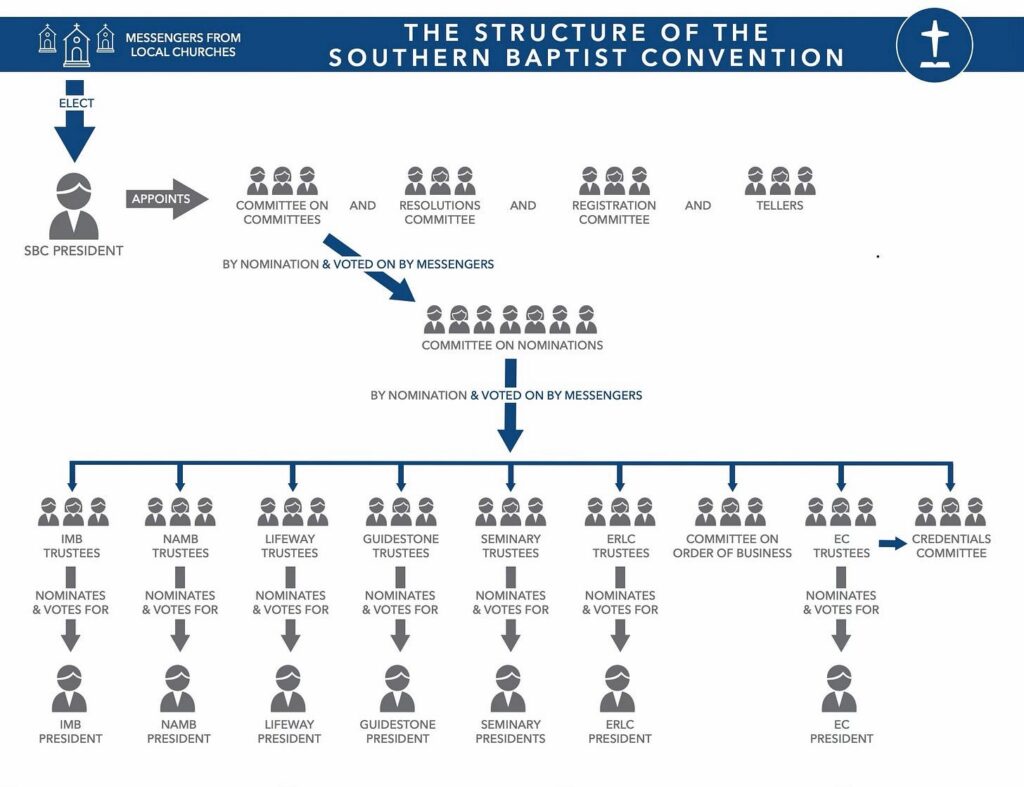
Entity trustees nominate and elect their entity presidents. But because trustee terms are staggered, institutional reform does not happen overnight.
It would take four trustee classes to fully rotate most SBC entities and five trustee classes to fully rotate the seminaries. In other words, assuming reformers continue winning the presidency, most entities could be fully rotated by 2031, while the seminaries would take until 2032.
If Willy Rice can deliver on his campaign promises, conservatives will gain additional support from ordinary Southern Baptists and moderates, potentially setting reformers up for success in two years, when they will need to put forward another candidate sympathetic to SBC reform.
If that happens enough years in a row, this could mark the beginning of a second conservative resurgence.
5. Expect increased opposition from people who are theologically conservative but functionally liberal
Most SBC elites, on paper, have conservative theology. They hold to inerrancy, they are complementarians, they affirm the right doctrinal statements, etc.
But many of these elites are functionally liberal. By that, I mean they are unwilling to fight for their conservative beliefs in practice.
Here is a tweet that captures this phenomenon well:
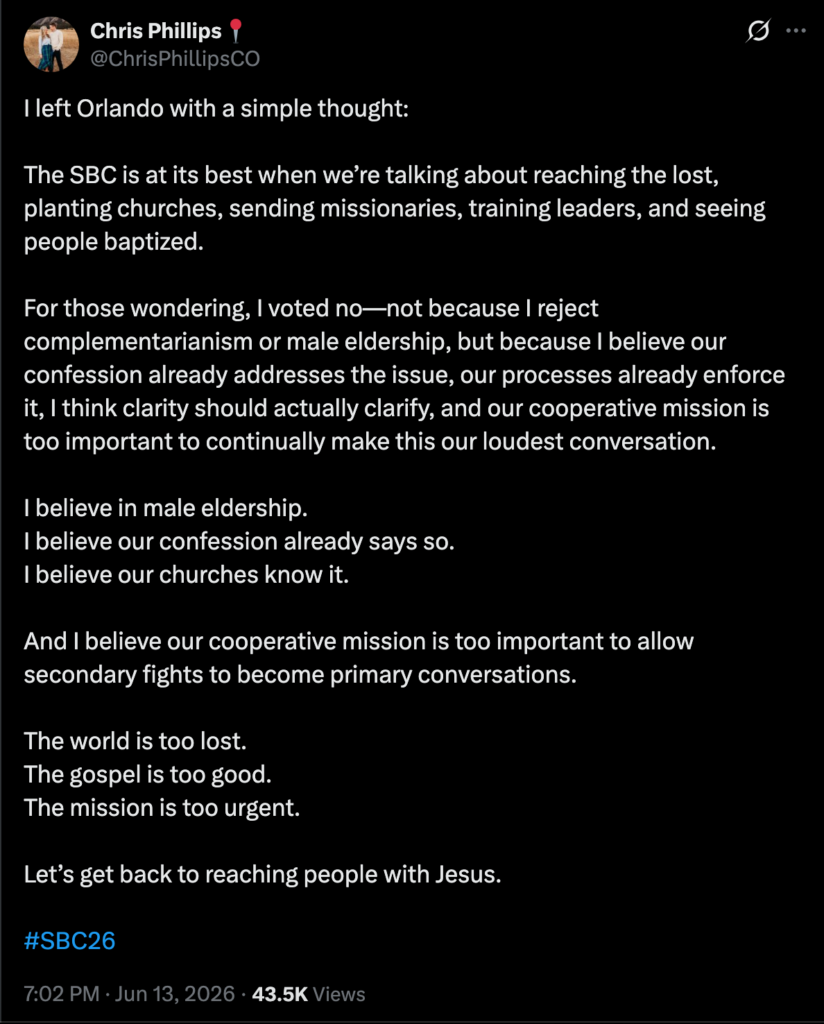
Many pastors are like Chris: they are unwilling to fight for their conservative convictions because they believe doing so is “divisive” or a “distraction” from the Gospel.
But the Gospel teaches us that Jesus is not just our Savior, he is also our Lord. We are not merely called to receive His free gift of eternal life, but to submit to and obey all that He has commanded.
We can, and should, do two things at once: Eagerly and joyfully share the Gospel while actively surrendering to the Lordship of Christ in every area of life, including our institutions.
That means guarding sound doctrine, ensuring our institutions operate according to our stated convictions, and refusing to treat obedience as a distraction from mission, but rather as crucial for its survival and effectiveness.
6. We need to capture the Normies before the Platform and the Loyalists do
If reformers want to build on the momentum from this convention, we need to do a better job of communicating with ordinary Southern Baptists (normies).
We have decisively won many arguments on X, but that is not the same as educating pastors, messengers, and church members across the country.
We need to disseminate information more effectively on Facebook, where more normie Southern Baptists are. We need to educate pastors in our own associations and attend associational meetings. We need to email our pastors important articles, posts, and resources.
We would also be wise to follow an 80/20 rule in our posting. Eighty percent of our posts and arguments should be framed positively. This means demonstrating the clear connections between our positions and what Southern Baptists hold dear. We need to tie our arguments to the Great Commission, Scripture, the BF&M 2000, and Baptist cooperation.
The other 20% of our postings can be more critical. There is a place for righteous criticism, calling out compromise, and naming names, just not at the expense of unnecessarily turning normies away from our movement. If we are nothing but flamethrowers, we will unnecessarily turn off the very people we need to persuade.
Conclusion
The future of the SBC depends on the strength of the next generation of Baptist men, both Millenials and Zoomers (like myself). Gen Z is tired of the woke nonsense they grew up with in their schools, in the culture, on social media, and now in the workplace. The last place they want to hear wokeness preached at them is a local church, or a Christian denomination.
The kind of leadership offered by Willy Rice and the Center for Baptist Leadership—unapologetically conservative and willing to fight to defend the faith from compromise at every point—is exactly what my generation wants to see, and will follow. If the vibe shift in the SBC brings us more men like Willy Rice in charge, it will bring more Gen Z baptists like me into the denomination, something the SBC sorely needs if it is going to thrive in the 21st century.
Because the goal is not merely to be right but to be effective and to win. The goal is to build a durable reform movement that ordinary Southern Baptists can understand, trust, and join for a better SBC, a better country, and a better world as God brings about His Kingdom through us.
There are many more important takeaways from the Convention (including those offered by my friends Pastor Rhett Burns here and Pastor Michael Clary here). Safe to say, the lowercase-r reformers gained a lot of ground this year.
The question for us now is: what are we going to do to capitalize on this momentum? Because if we can, I am confident that thousands of more Gen Z Baptists like myself will be attracted to the SBC and eager to join, helping energize the gospel work of the SBC for decades to come.
Editor’s Note: This is an edited version of an article originally published on Dustin DeVito’s Substack.
Share This Story