
If things don't change, America will soon have more empty pulpits than pastors to fill them
You often hear that we are in a “pastoral crisis.” In a nutshell, the “crisis” is that the older generation is dying off and fewer young, faithful men are going into the ministry.
Already and increasingly so, we will have more empty pulpits than men to fill them.
It’s not a new problem, though as it gets worse, it is receiving increased attention. Back in 2017, George Barna observed that the median age of pastors in the U.S. was 54—a significant increase from just 25 years prior:
“When George Barna published his 1992 findings in Today’s Pastors, the median age of Protestant clergy was 44 years old. One in three pastors was under the age of 40, and one in four was over 55. Just 6 percent were 65 or older. Twenty-five years later, the average age is 54. Only one in seven pastors is under 40, and half are over 55. The percentage of church leaders 65 and older has nearly tripled, meaning there are now more pastors in the oldest age bracket than there are leaders younger than 40.”
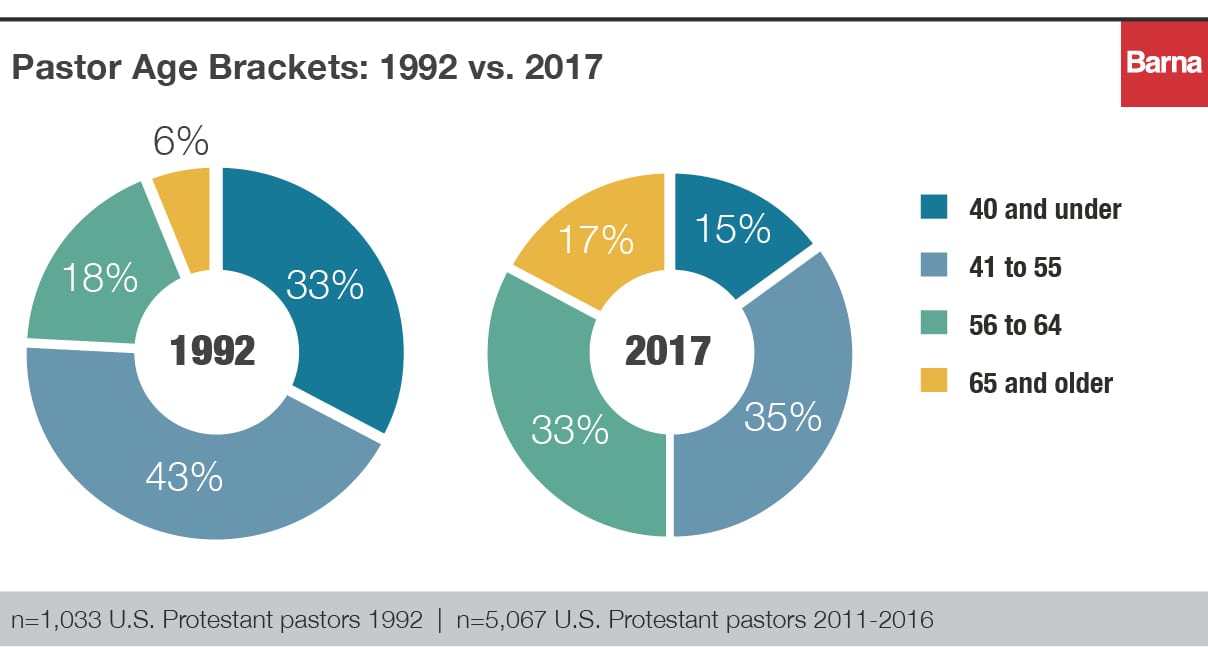
That was ten years ago. Each year, those pastors get older, and fewer young men are stepping into the ministry to replace them.
As one piece of anecdotal evidence to this growing issue and the growing concerns about it, an associate pastor in the PCA recently asked, “Why are so many churches (PCA and otherwise) struggling to find pastors?”
The replies to this post were illuminating. One that I found particularly thoughtful was from pastor Michael Foster. He offered four brief thoughts, some of which were particular to the Presbyterian NARPAC denominations and some that were more general.
But even his PCA-specific observations, such as a “damaged reputation” with younger men, I think also apply to my own denomination, the SBC.
Ultimately, there is no monocausal explanation for this crisis, nor a silver bullet to fix it. That doesn’t mean it can go unaddressed. The generationally-driven pastoral supply crisis is here. And as a young (under 30) senior pastor, I care deeply about the future of not just my own Southern Baptist Convention, but the wellbeing of the church in America.
From my time in seminary and serving as a pastor, here are three of the primary causes I have observed resulting in increasingly aged and empty pulpits.
A Tight Generational Grip on Pastoral Opportunities
In a recent post on social media, Mark Clifton observed the reality that a huge swath of the older generation could be ushered into heaven soon. His recommendation: the older generation needs to loosen its grip on leadership and allow the next generation(s) to step up.
If anyone has authority to speak on such things, it’s Mark Clifton. Several times a pastor and presently the Executive Director of Replant & Rural Strategy for NAMB, Clifton knows what church leadership dynamics look like. Undoubtedly, he has helped more churches think through their next pastor search and strategy for leadership transfer than the average person.
I have observed, albeit to a much lesser degree than Clifton, that the older generations presently holding on to leadership in the church can be hesitant to hand it over to the younger generation. Ironically, not in my own ministry. At the church where I pastor, my predecessor had been the pastor for 30 years and was approaching his 80th birthday. When our Association Missions Strategist approached him about a possible succession plan, he was happy to see a young man step into leadership. We had to get creative and raise some money, but I took over for him three years ago, and he remains in our church as one of my biggest supporters.
I fear that’s the exception, not the rule. More often, what I have seen in other churches, in my town and state, is many pastors hanging on to their pulpits well into their late sixties and seventies when their church could otherwise hire a new pastor. Nothing is sinful about that, but it does continue the trend of older pastors getting older and the young men not taking over.
Likewise, and I think this is what Clifton is also getting at, there is often a problem with the laity being willing to follow a young man. In my years, I have done my fair share of searching for pastor jobs. If the church is looking for a Senior Pastor, the odds are they will state explicitly that they are looking for someone with 7-10 years’ experience in a similar role. Other times they will be even more blunt and put an age range of mid-thirties to early fifties.
Again, there is nothing sinful about that. But it does allow the trend to continue. Both the pastors on staff and the laity in the pews need to, as Clifton urges, be willing and ready to follow and empower younger leaders still cutting their teeth.
Increasing Aspirational Apathy Among Younger Men
During my time in seminary, I met more young men uncertain of their calling than certain they wanted to graduate and take up a pulpit. I will grant that it could have been the odd circumstances of time and place. But I will tell you, many of the friends and guys I met in seminary went on to work in the secular field or for the school as they remained in town, and some pursued doctoral work. Plenty of them were honest about not feeling the kind of aspiration that Paul encouraged Timothy to look for in prospective pastors (1 Timothy 3:1). But that does add to the issue.
Seminary enrolment may be increasing, but is it increasing with men who want to be pastors?
Other men I went to seminary with knew they wanted to be a pastor one day, even a senior pastor, but didn’t want to do it anytime soon. Many of those friends of mine got jobs on campus or at an associate pastor level serving a larger church. The latter, in particular, at least puts a young man on a pastoral track, but it only increases the number of brothers not serving as senior pastors or sending out their resume to such roles. Instead, they appear to be waiting for the right opportunity to arise instead of pursuing the opportunities that exist.
If my admonition to the older generation is to loosen their grip on pulpits across America and give younger men a chance, my admonition to younger men pursuing ministry is to loosen their grip on the “idealized” pastoral opportunity someday down the road—and be willing to fill real pulpits today.
This is especially true for empty pulpits in small churches that we might classify as revitalizations. These churches have fallen on hard times but have institutional resources – a building, cash reserves, etc. – and just need a new leader who will come in, be patient, and shepherd them back to health.
Church revitalization is often uncomfortable. Pastors of such churches go to a body where they might be the youngest members, there might not be any other kids, and the doctrine/practice of the church is not ideal. But if those churches cannot find a younger pastor, full of energy, to do the work necessary to bring life back to its ministry, those churches will inevitably either be renovated into apartment complexes or bulldozed over for a fast-food restaurant.
If a brother will step into the uncomfortable, he can shepherd them back to health. But he must want to be a senior pastor sooner rather than later.
Mounting Economic Barriers to Entry for Full-Time Ministry
I don’t have to tell you that the cost of living is pretty high right now. The national average for a family of three is between $85,000 and $100,000 per year. In the American Southeast, that average is a little lower, closer to $80,000.
And here’s the rub: most normal churches are not paying their senior pastor that much.
According to Lifeway’s compensation survey, for churches with an average attendance of 150 or less, the median pay package for the senior pastor is $71,000. Okay, that’s not so bad. But when you start looking at average attendance below 100, the number only decreases.
This has two main reasons. First, plenty of churches don’t want to pay their pastor a living wage. Unfortunately, I know several men who have left vocational ministry or never stepped into full-time vocational ministry because the numbers just didn’t add up. The churches that would consider hiring them sometimes had plenty of money, if not in the budget, then in reserves, to pay a good salary. But they simply didn’t see the need to pay a pastor so much. This is bad, to say the least. Unfortunately, many laity in churches, for one reason or another, want to save as much money on payroll as they can.
Second, some churches just don’t have the money. And the unfortunate reality is that as the world gets more expensive, the small churches will be increasingly priced out. These churches would love to offer more than they can, but they don’t have the budget or the savings.
In such cases, creativity is required. Some churches may not have the money in the bank to pay a full-time pastor with a young family a living wage, but maybe they have a parsonage that can be used to provide free housing. If this is your church, please do not sell your parsonage or convert it into an office space. With housing prices and interest rates as high as they are in most places, your parsonage will likely be an extremely valuable resource in the hiring process.
Likewise, if you are a larger church with a parsonage, or mission house, consider lending it to a small church so they can use it to house a pastor. Housing is one of the major contributors to pastors being able to afford to raise a family and serve in the ministry.
At my church, they could not afford to pay me as much as I needed. So we got creative. They had a parsonage and helped to spruce it up for us. We partnered with half a dozen churches in our county to raise an additional $20,000 that would go to my salary for the first year. And at the end of the first year, the church had grown enough to bridge that $20,000 gap. Creativity and willingness can go a long way.
Conclusion
The pastoral crisis is here. There are many reasons for it, more than I have covered in this brief article, but it is here, coming, and getting worse. And the solutions will need to be both practical and spiritual.
We need to pray to God to raise up more men who aspire to step into the gap and that the older generations will gladly welcome them into leadership.
We also need to get practical. Denominations and churches need to find ways to offer salary and housing packages that offset the real and rising cost of living in this economy, empowering qualified men to step out of the workforce and into the pulpit.
I know I’m not alone when I say that I do not want to see a world where the empty pulpits lead to empty pews. If that is the trend, then let’s do what we can to reverse it. One pastor at a time.
Share This Story