The IMB's vaccine mandates are forcing missionaries off the field; a growing chorus of voices are asking for a change
On Tuesday, September 15, SBC messenger Mike Schneider from Faith Community Church in Kansas City, Missouri, issued an open letter to the trustees of the SBC’s International Mission Board asking the IMB to update their vaccine mandate policy and favorably respond to his motion from the 2026 SBC annual meeting requesting the same.
The request is simple and straightforward: That the IMB would change its vaccine mandate policy to accommodate the consciences of missionaries pertaining to the production of a vaccine (the issue in view here is if a vaccine was derived from the fetal tissue of aborted babies), and in allowing parents and families to weigh the risks and benefits of any particular vaccination that is not mandated by the United States or the country of service.
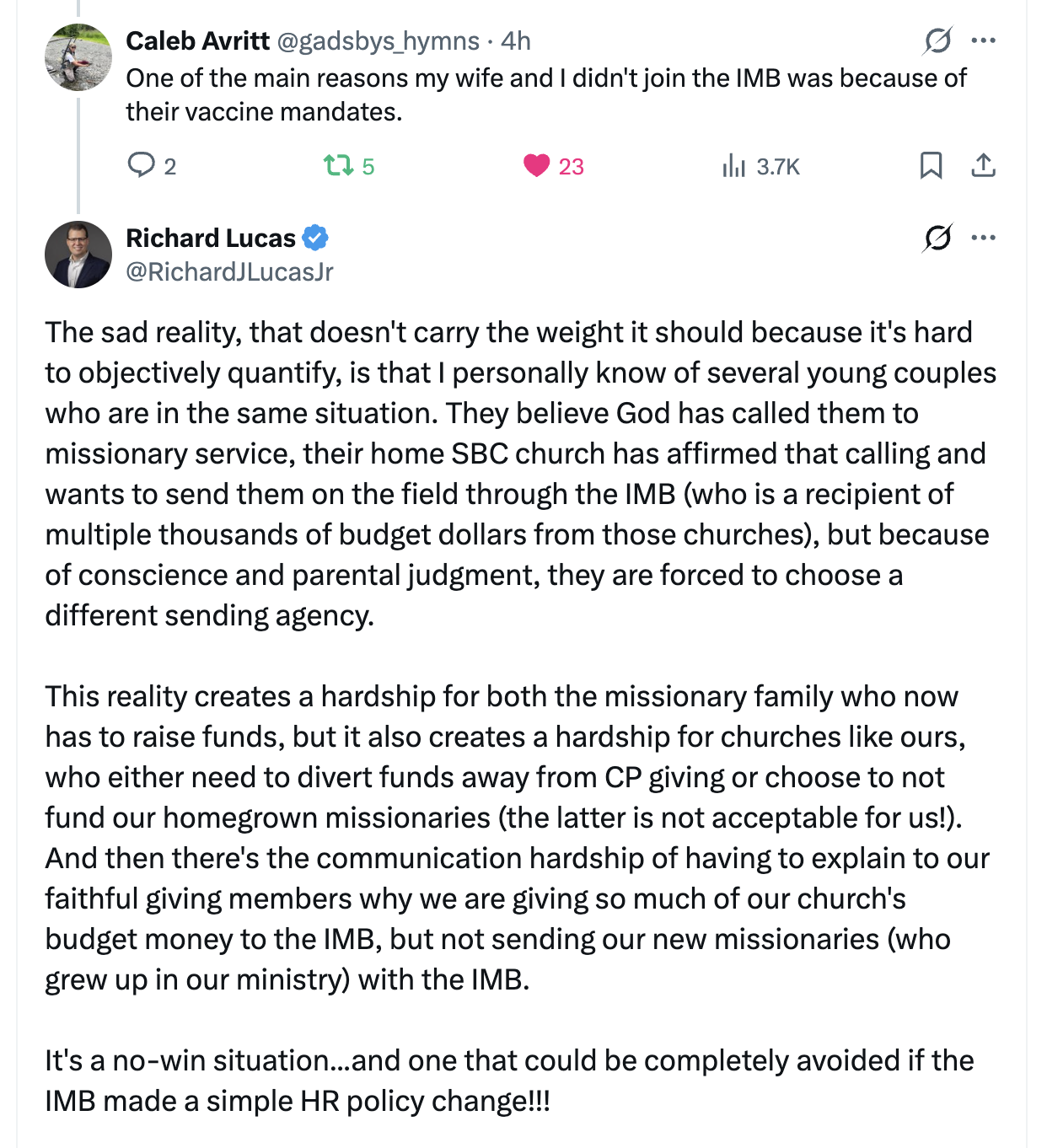
Schneider’s ask was joined by a supportive chorus of of SBC pastors, former missionaries, prospective missionaries, and lay members on social media—including SC pastor Rhett Burns, who called it a matter of “liberty of conscience,” CO pastor Jon Helvoight, and FL pastor Richard Lucas from First Baptist Jacksonville.
Lucas expressed his strong support for the IMB but also issued a call for them to change their “heavily-handed” policy that “removes parental rights and doesn’t protect freedom of conscience.” Lucas also explained that this is not a “theoretical” issue, but one that is removing missionaries from the field right now: “IMB missionaries are being forced to leave the field because of this unnecessary and draconian HR policy. This problem is not theoretical, but is already happening!”
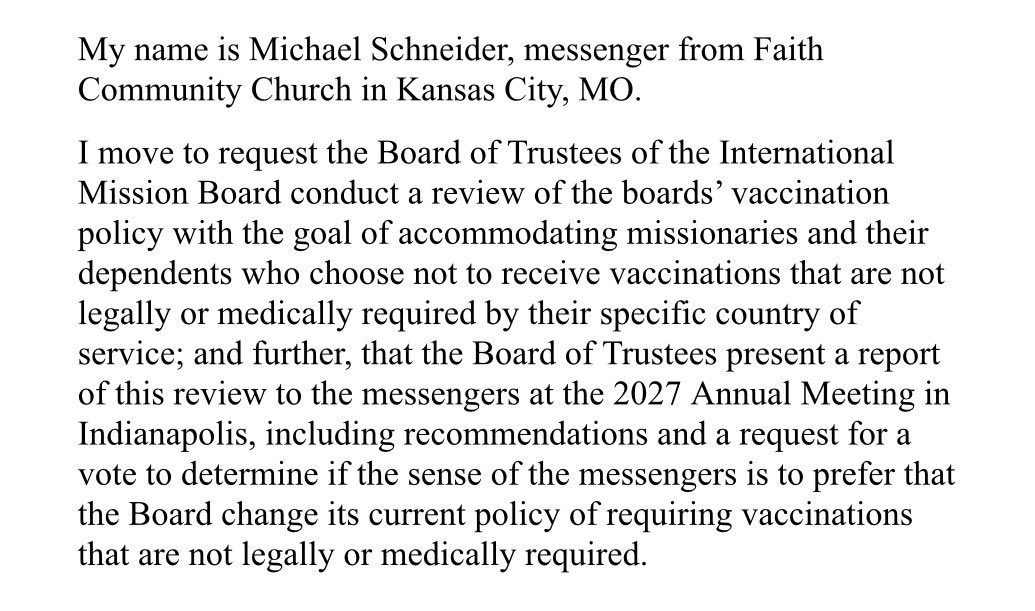
The full text of Schneider’s 2026 motion asks trustees to review the policy “with the goal of accommodating missionaries and their dependents who choose not to receive vaccinations that are not legally or medically required by their specific country of service.” It further asks the board to report to messengers at the 2027 annual meeting in Indianapolis, with recommendations and a vote to gauge whether messengers would prefer that the policy change.
Along with making this motion, Schneider also directly asked IMB President Dr. Paul Chitwood about the current policy at the recent annual meeting, which you can watch below.
Schneider’s motion was referred to the IMB’s board of trustees, and so now he has issued an open letter to all of the trustees on the eve of their fall meeting, urging them to replace the blanket immunization requirement with a policy that respects the Baptist principle of liberty of conscience.
Trustees convene near Richmond, Virginia, September 16-17. It is their first meeting since messengers in Orlando referred two motions on the policy to the board.
According to Baptist Press, a second motion, from John Jones of Missouri, asks that full-time missionaries be permitted to opt out of vaccines that violate their consciences.
What the Letter Asks
Schneider does not ask the IMB to abandon vaccination. Instead, he asks for flexibility. The current policy, he writes, requires missionaries to receive a wide-ranging set of immunizations whether or not their country of service presents a significant risk. A revised policy would allow the IMB to accommodate missionaries’ consciences on two fronts: 1) how a vaccine was produced, and 2) how a family weighs the risks and benefits of a particular vaccine for its own members—especially their children.
The first of those fronts carries particular weight for pro-life Southern Baptists. Three vaccines the IMB requires – MMR (through its rubella component), varicella, and hepatitis A – are grown in cell lines derived from two children aborted in the 1960s, and no alternative is licensed in the United States. Under the current policy, a missionary whose conscience forbids those vaccines has no path to the field that does not require violating it.
Schneider grants the policy’s outer boundary, as his motion did in Orlando: accommodation extends only to vaccines not legally or medically required by a missionary’s country of service. His objection is to requirements that reach beyond it. As it stands, he writes, the policy “drums out good missionaries whose convictions will not allow them to conform.”
Or, as Dr. Samuel Parkinson at Midwestern Baptist Theological Seminary put it, the IMB’s “vaccine policies are extreme and keep good missionaries off the field.”
A Family’s Resignation
At the center of the letter is a friend who “reluctantly resigned from the IMB just this summer,” after the annual meeting. He had served with the IMB at every level: short-term, Journeyman, and career. He expected to remain until retirement. His first child, a daughter, was born overseas less than a year ago. When the family sought medical clearance to return to the field after a furlough, they were told they could not go back until she was caught up on her childhood vaccines. The parents wanted a delayed schedule out of concern for side effects; IMB medical instead pressed an accelerated one.
“In essence they were forced to choose between serving with the IMB or making the best choice for their daughter,” Schneider writes. “A choice that should not be necessary in the first place.”
Schneider identifies the family as one of two couples chronicled in the article “Sent Home: How the IMB’s Vaccine Policy is Forcing Missionaries Off the Field.” The details match the family that the report introduced under the pseudonym James and Rachel Collins, who at the time had been denied medical clearance but still hoped to continue serving.
Sadly, that was not the case. Their resignation is new and heatbreaking news. Schneider adds that similar accounts have surfaced since.
He closes by pressing the IMB’s own mission language back upon the board. How, he asks, can the IMB expect to reach the most remote unreached people groups “if you maintain policies that force courageous Baptists to violate their conscience?”
A Question the IMB Has Heard Before
The question is not new to the convention floor. In 2021, John Jones, pastor of Cadet Baptist Church in Cadet, Missouri, asked IMB President Paul Chitwood to look into changing the board’s vaccine requirements.
In 2022, his motion asking the IMB to provide a way to exempt missionaries from actions of conscience, such as receiving vaccines, was ruled not in order. In 2023, he tried again, asking that the IMB allow missionaries to abstain from vaccinations that go against their consciences, and this time the motion was referred to the board. At the same meeting, Chitwood told messengers that the IMB’s list of vaccinations is “simply a requirement of serving with the IMB.”
The IMB’s written response, published in the 2024 Book of Reports, changed nothing; its leaders committed only to “continued careful consideration” of health care requirements in light of the factors it listed, from medical and ethical concerns to financial cost. Questions raised at the 2025 meeting prompted two reviews – one by the IMB’s medical team and one by an outside panel – which Chitwood reported in Orlando had affirmed the policy with a single change: moving one vaccine from required to optional. As Chitwood described them, neither review took up the conscience question at the heart of Schneider’s motion.
What Comes Next
Under SBC Bylaw 26B, motions concerning an entity’s internal operations are referred to that entity’s board for consideration and report to the next annual meeting. The entity must respond in writing in the Book of Reports, stating how the matter was considered, how it was reported to Southern Baptists, and what action, if any, was taken. Whether the referrals will come before trustees in Richmond has not been announced.
Schneider’s motion requests more than the bylaw requires. Beyond a written response, it asks for recommendations and a vote in Indianapolis on whether messengers prefer a change in policy, giving the messengers a voice in the outcome, not merely a report on it.
While the reviews Chitwood cited answered whether the policy is medically defensible (and that is debatable), Schneider’s letter puts a different question to the men and women who govern the IMB:
What is the current policy costing our global gospel mission—and whether a Southern Baptist entity should make the violation of a missionary’s conscience the price of going to the nations?
Share This Story