Can Christians participate in IVF without being complicit in its evils?
“IVF attempts to reverse the fall by overcoming infertility. But when God’s means are ignored, and our own ingenuity replaces what God has designed, we come dangerously close to playing God.” Dr. Josh Holler
Have you given much thought to in vitro fertilization (IVF)? Perhaps you have. But many haven’t. And that “many” includes many well-meaning, pro-life, conservative Christians.
In his recent book, pastor Dr. Josh Holler (PhD, MBTS) argues that these pro-life Christians, and the American church as a whole, have not truly reckoned with the real moral perils and problems pervasive in the IVF process and industry.
In Misconceiving IVF: An Essential Guide to the Perils of In Vitro Fertilization, Holler patiently and pastorally labors to open our eyes to the unavoidable realities, ethical dilemmas, and theological implications surrounding IVF.
For some personal background, my wife and I are passionately pro-life. She has worked for two pregnancy resource centers.
I’m also a pastor. What’s more, I am a Southern Baptist pastor. And in 2024, the Southern Baptist Convention annual meeting passed a resolution, “On the Ethical Realities of Reproductive Technologies and the Dignity of the Human Embryo,” warning that the “In Vitro Fertilization process routinely generates more embryos than can be safely implanted, thus resulting in the continued freezing, stockpiling, and ultimate destruction of human embryos, some of whom may also be subjected to medical experimentation.”
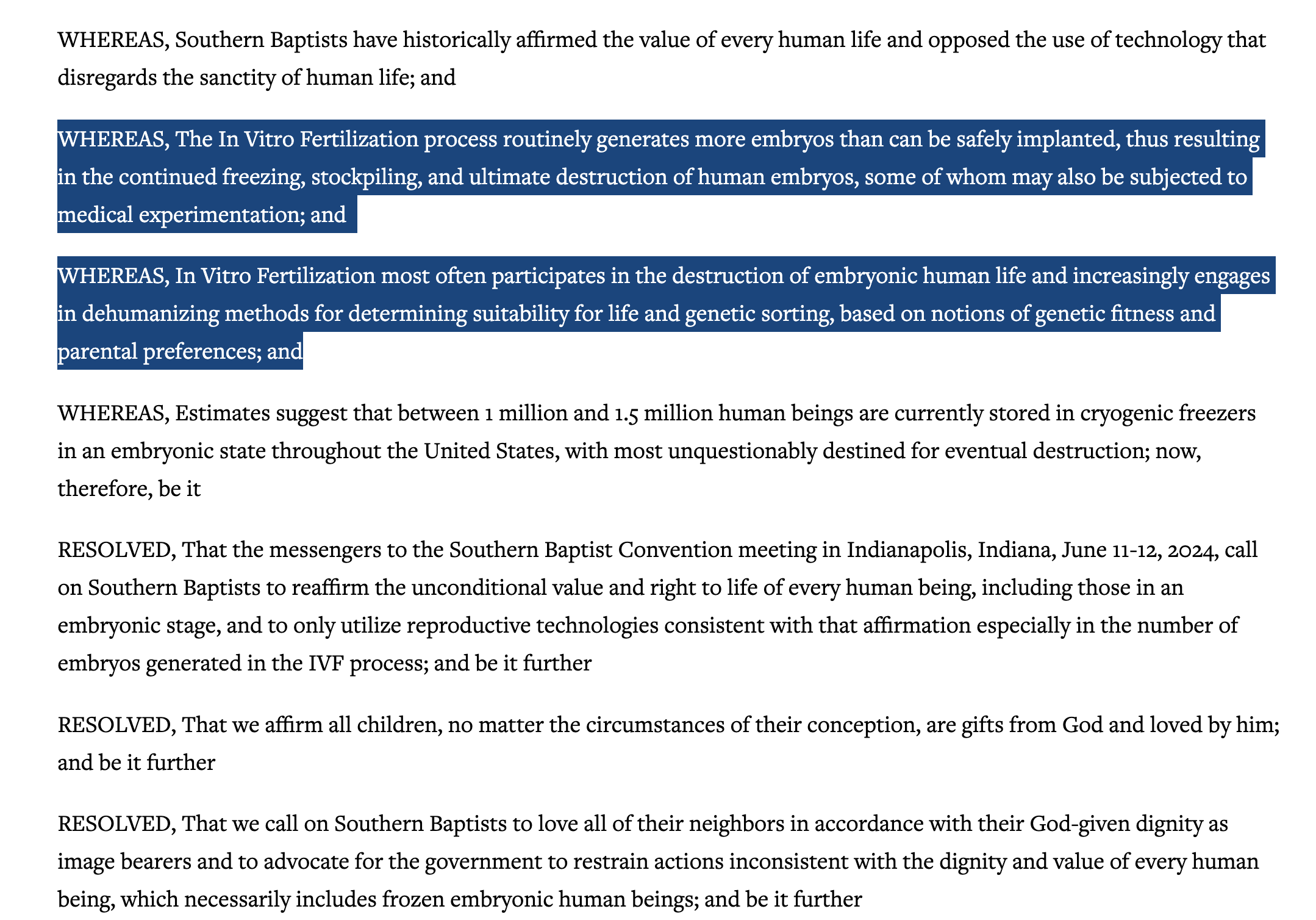
The resolution passed, and I voted to adopt it.
The point of mentioning all of this is to admit that if ever there were such a conservative Christian who had reason to have some awareness about the morally dubious nature of IVF, it would be me.
And while I did approach Misconceiving IVF with a baseline posture of agreement with his concerns, what I encountered in his book still significantly reshaped my understanding of and moral analysis of IVF.
Now, I not only agree in principle with Holler’s argument that IVF should not be pursued by Christians, but I also have the knowledge to back up that controversial claim, and a resource to recommend to those who are wondering if Christians can or should use or support IVF.
Well-Researched
One of the clearest strengths of Holler’s work is his research and the resources he provides. Holler has approached this work from his Christian worldview, but that has not stopped him from doing his homework. It would be very hard, if not impossible, for readers (even the skeptical ones and those who disagree) to fairly accuse Holler of having jumped to conclusions.
Likewise, in every morally ambiguous area, Holler has gone the extra mile to present the facts and realities without speculation. From the cost of IVF (financially, physically and emotionally, relationally, and spiritually) to the lives lost throughout (Holler reports that “the loss of life because of IVF is somewhere between 4.3 and 5.5 million babies” from 2013 to 2022 alone), Holler presents the statistical facts and harrowing numbers (50).
He does not employ his research for emotionalism or shock value. Rather, Holler presents the realities and allows them to speak for themselves. If you want a concise look at the medical, economic, and societal impact of IVF, Holler has done admirable work in compiling the data for his readers.
A Powerful Moral Evaluation
Perhaps some pro-life readers will be familiar with the research mentioned above. They likely have some knowledge of the financial cost, the lives lost, or the fact that many embryos are left in storage for years (and even possibly experimented on or destroyed). These are realities I already had some knowledge of, but Holler’s book pressed the dark side of IVF into the light patiently, forcefully, and clearly.
But I believe the greatest value of Holler’s work lies in its middle four chapters, where he walks through the key ethical dilemmas of IVF. The sheer number of embryos, which is to say babies, who are developed and never given a chance at life is staggering. It is far and away the majority of babies conceived through IVF who either never make it to the womb or die of miscarriage after implantation. Miscarriage, as Holler shows from the data, is far more common through IVF (51).
But the massive quantity of lives lost through IVF does not happen in the womb. More embryos are fertilized than will ever be used. They are either discarded, frozen indefinitely, or destroyed (49). This is after a couple has spent tens of thousands of dollars – money that often doesn’t even result in a successful pregnancy (79). The cost is high, indeed.
There are two additional areas of Christian ethics and IVF that Holler expands upon, which I believe are why his work will stand the test of time: complicity and the one-flesh union.
Holler makes the case, convincingly, that there is no way to participate in IVF without being complicit in its evils. Even if a Christian found a way to do IVF which created only one embryo and wasn’t too expensive, they would still be participating in a system that drains bank accounts and results in millions of dead children. Until the entire system is reformed such that it is not for-profit and creates only the number of babies one intends to have, Christians seeking to do IVF ethically will be complicit in the system’s crimes.
Then, even if we were to create a world wherein IVF is cheap and never results in unwanted embryos that are discarded, Holler exposes a critically important element of IVF’s morality. In and of itself, IVF disrupts the natural order of the one-flesh union in which children are meant to be conceived. Not unlike Abraham and Sarah introducing Hagar into their one-flesh union, Holler argues IVF always introduces a third party into the union of man and wife. Added to that, the extraction of the elements – especially how a man is to give his sample – is totally against the natural order of God’s creation. IVF, even if it is cheap, only creates one embryo at a time and, far into the future from its more grim past, will never escape the ethical dilemma of being against natural law.
Holler’s exposé of the ethics behind IVF reveals to the Christian that there are really no moral grounds for a couple to participate in the process. While the research will change over the years, Holler notes, more than once in the book, that prices and costs may have risen between the book’s writing and printing. As such, this section of Misconceiving IVF will stand the test of time.
A Pastoral Charge
Holler’s book aims to convince his readers of IVF’s moral perils. I believe it accomplishes that goal. But he does not aim merely at information, nor does he only intend to convince his audience away from IVF.
One of the strengths of Misconceiving IVF is that Holler concludes with a charge to his Christian audience to consider how we might change the landscape. Holler charges the Christians to take a consistently pro-life stance toward IVF. As he observes, the desire to use IVF stems from a longing to have children (151). On its surface, it appears rather pro-life to provide an avenue for more babies to be born. If this is not the case, as he argues, then what should Christians do to start working to end the IVF indusrty? Many of the solutions currently offered are often surface-level or primarily legislative, and those are important (152). But Holler argues that what is needed is an entirely new approach to get to the heart of the matter.
One solution Holler provides is to re-engage in adoption. In the advent of IVF, adoption became perceived as a second-class solution (143). But for the Christian, nothing could be further from reality. Holler’s concluding charge to the church to take up the mantle in reshaping the conversation around IVF and having children through other means concludes Misconceiving IVF with the warmth and challenge of a pastor.
A New Babel. A New Tower
I picked up this book because I knew IVF was a matter of controversy in the pro-life movement. I already knew I was against IVF, but as I look at a conservative movement and a Republican Party – including the White House – which increasingly advocates for IVF as a part of the “pro-life agenda,” I concluded, “I need some help understanding this issue.”
Misconceiving IVF is the perfect resource for Christians who want to learn more about IVF in every facet. After reading, it became clear to me that, despite the impressive scientific and technological feats involved, IVF is a means of making a name for ourselves (Genesis 11:4); or rather, a family. We cannot (or should not) try to become co-creators with God outside of God’s design for creation, that is, procreation inside the marital one-flesh union. And these scientific and technological attempts to create life outside the womb have resulted in far more lives lost than gained. I am grateful to Dr. Holler for his work on this book, even though others may disagree.
If you are a pastor, buy this book. Buy several of them. Share them with church members. If you are considering IVF, please read this book. If you are someone who has had biological children, read this book. And no matter who you are, I would recommend buying and reading Misconceiving IVF and consider how God might use you to help stop the normalization of a process that has killed millions of preborn babies—and, if unchecked, will kill millions more.
Share This Story