
For the sake of our Great Commission work, SBC leaders must ask themselves why is CP giving declining year after year
The Southern Baptist Convention’s new fiscal year is off to a familiar start, with Baptist Press reporting last week that Cooperative Program (CP) giving for October came in 2.52% below its monthly budget goal. That news follows last month’s year-end report, which Baptist Press headlined reassuringly: “Cooperative Program giving remains the same year over year.”
On its SBC “This Week” podcast recapping last year’s CP giving, the hosts called the results “pretty encouraging.” One host even suggested some people have “prematurely talked about the demise” of the CP and later remarked that “in a year in which the economy was not great, and gas prices were crazy high, and grocery prices are going up all the time,” the fact that the CP “just held steady was really encouraging.”
It is worth celebrating how generous Southern Baptists are even in the midst of a tough economy. But the same rising prices that squeeze family budgets also squeeze the missionaries, church planters, and seminaries the Cooperative Program supports. When giving stays flat and costs continue to climb year after year, our gifts don’t go as far as they used to.
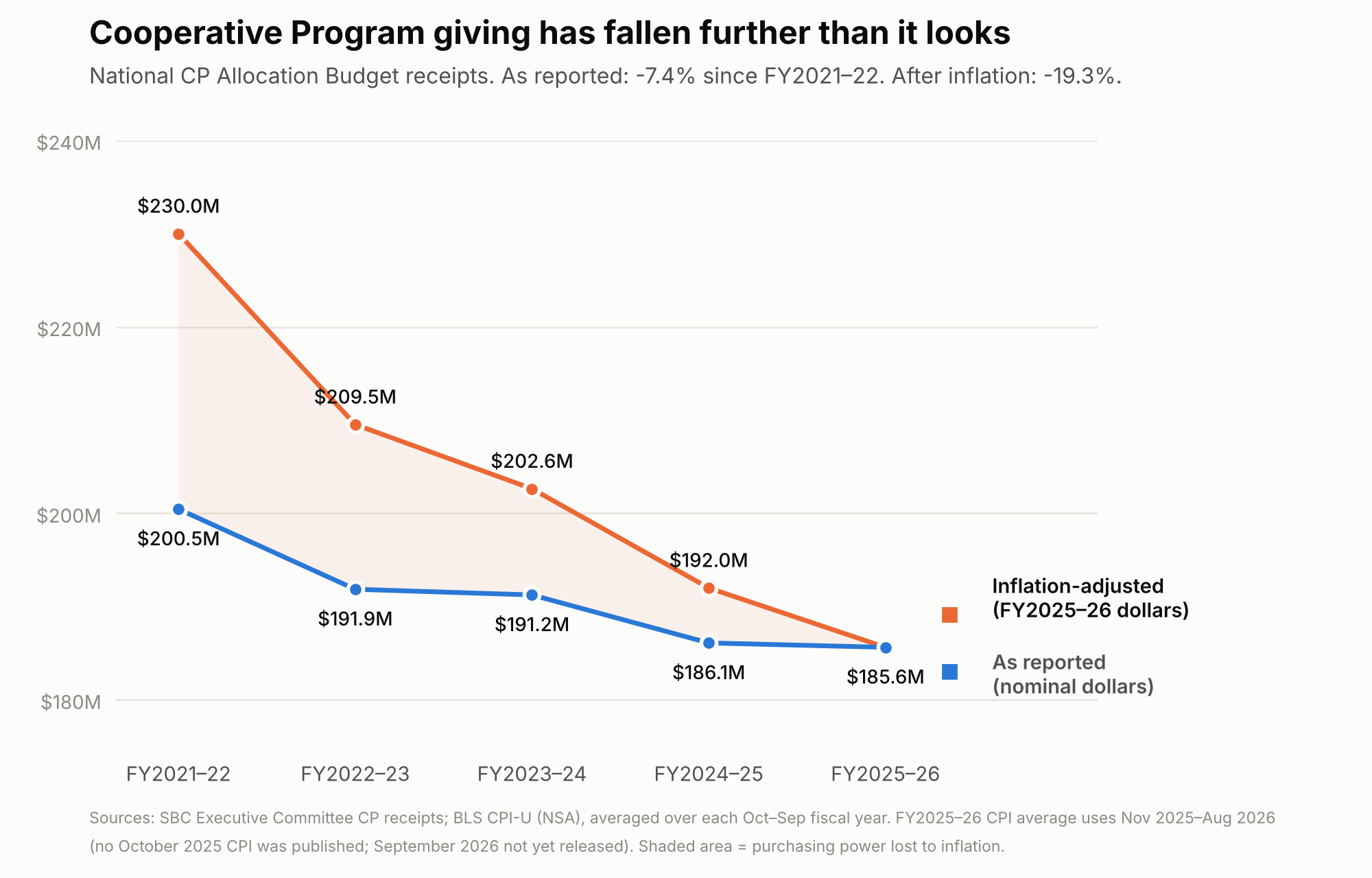
Unfortunately, this past fiscal year was not an exception to the decline in giving. National CP receipts this year ($185.6 million) are about what they were in 2003 ($183.2 million), when a dollar went much further than it does today.
Since fiscal year (FY) 2021–22, prices have risen about 15 percent, so ministry that cost $100 then costs about $115 now. In other words, to fund the same work in 2025-26 that churches funded in 2021–22, the national CP receipts would have needed to be about $230 million.
Adjusted for inflation, the FY 2025–26 receipts of $185.6 million are down 19.3% since 2021–22, roughly $44 million less buying power for the entities that depend on Cooperative Program money. It is also worth noting that the Convention fell $4.38 million short of its own $190 million budget.
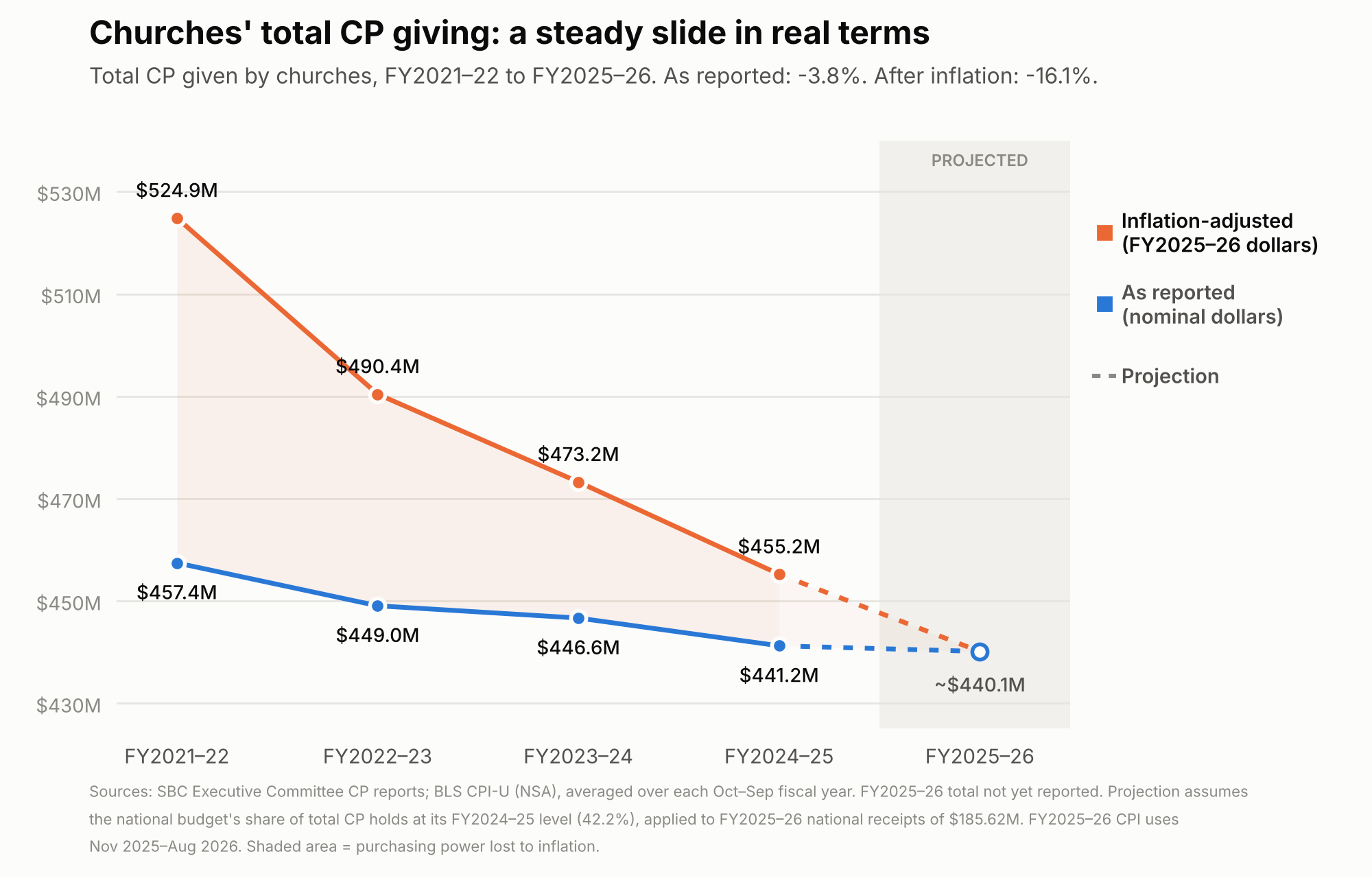
Some might argue the national numbers are down only because state conventions are keeping a larger share of money before passing the rest along to the Cooperative Program. However, this is not what the numbers show. Total CP giving by churches, before any money is divided between state and national ministries, fell 13.3% in real terms between FY 2021–22 and FY 2024–25, the most recent year reported. If the national budget’s share holds steady, that decline will reach about 16% for FY 2025-2026.
Think of a business whose real revenue had slipped nearly 20% over five years. Its board wouldn’t be in a full-blown panic, because this wouldn’t mark imminent collapse. But it also wouldn’t call the annual report “pretty encouraging.”
Board members would ask hard questions about what’s driving the trend, and they would likely bring in stakeholders and consultants to help understand it. The Cooperative Program is, of course, not a business, but the stewardship stakes are even higher.
For the sake of our Great Commission work, SBC leaders should ask themselves a simple but serious question: Why is CP giving declining year after year?
There are undoubtedly many factors. For Gen Z Baptists like me, one clear factor is a lack of transparency. The less we know about how our entities spend our gifts, the less reason individuals and churches have to give through the CP rather than around it.
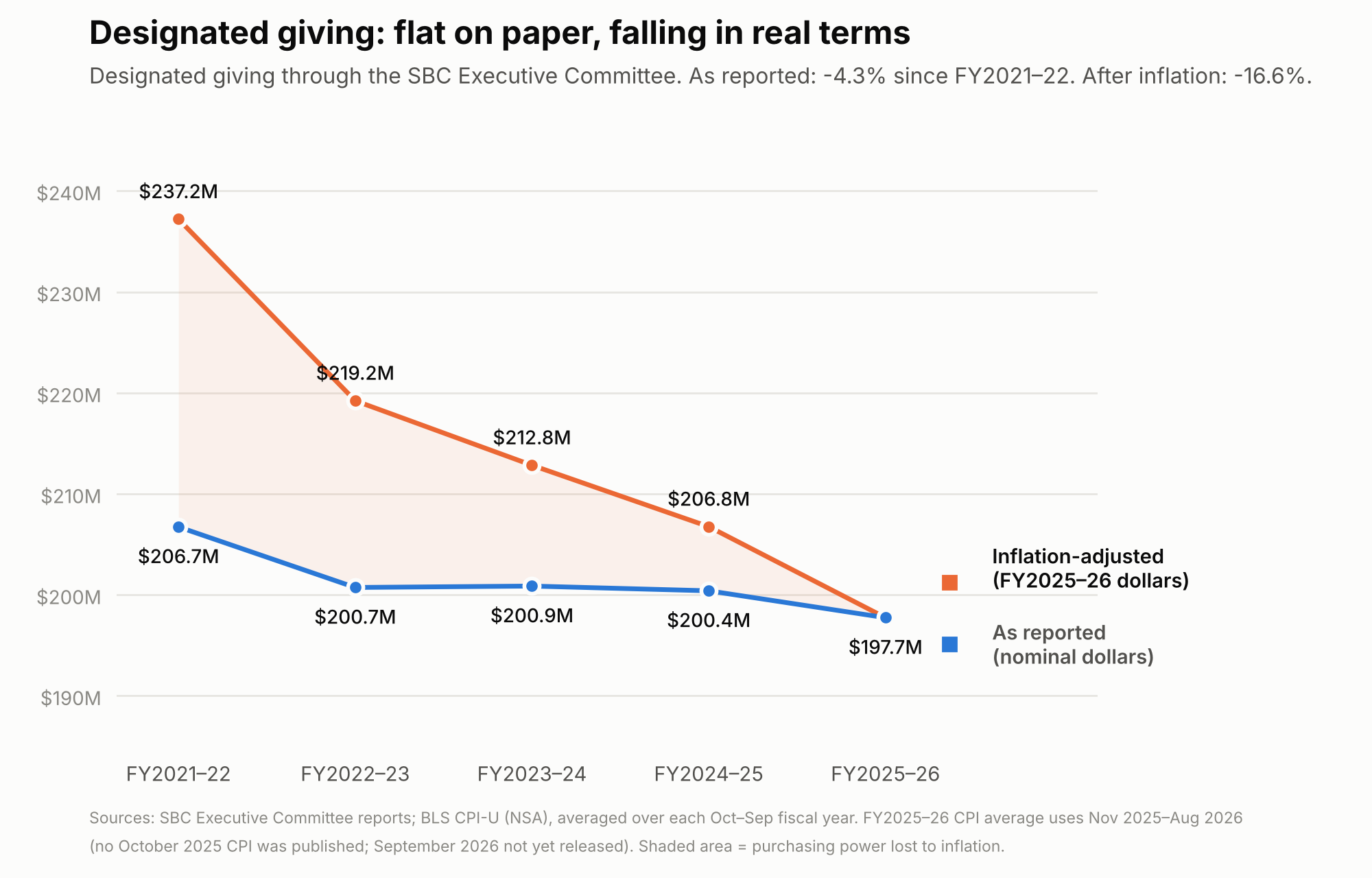
I know plenty of Southern Baptists who now designate their gifts to particular entities or missionaries because of exactly these concerns, and the numbers bear this out. Since 2000, designated giving has risen from $163 million to $197.7 million, while national CP receipts have slightly increased, from $178 million to $185.6 million. Designated gifts now regularly exceed CP receipts.
Among some Southern Baptist elites, the prevailing view is that the transparency problem has “already been solved.” SBC This Week made the case that the issue of financial transparency had already been meaningfully addressed, crediting Executive Committee President Jeff Iorg with leading the way on transparency through the new Business and Financial Plan and its annual “accountability letters.” Messengers can read the letters in the SBC Annual and “see just about everything you would want to know,” one host said, adding that they “include the information that messengers have asked them to include.”
But in several important ways, the new plan is less transparent than the one it replaced. Under the old plan, messengers could access records on entity income, expenditures, debts, reserves, operating balances, and salary structures. The new plan drops that access and no longer requires Convention approval of maximum reserve levels. It also requires entities to report contribution revenue as totals grouped by categories, leaving questions about how the revenue was raised or from whom.
The accountability letters are meant to fill those gaps, but fall short. Each letter is signed by the entity’s board chair and president. It affirms that compensation policies are “appropriate,” that presidential expenses are appropriate, and that the entity has “not directly solicited churches for financial support” (outside of a few specific efforts like the Lottie Moon and Annie Armstrong missions offerings).
Audited financial statements are also published, which is a good thing. But affirmations are not the same as disclosure, and much of the plan rests on self-reporting rather than clear disclosure standards. Even the hosts acknowledged that the letters leave out “executive salaries and things like that,” that the plan “does not specify a format,” and that some letters “just kind of check all the boxes.”
This is in stark contrast with the kind of information nearly every nonprofit in America already makes public, including:
- what top executives and the highest-paid employees make
- which outside contractors receive large payments
- business dealings with officers, trustees, and their families
- whether a whistleblower policy is in place
Many Southern Baptists have asked SBC entities to voluntarily disclose this kind of information, but none of it is published under the current plan. Executive pay is “described” only on written request. Conflict-of-interest statements are collected but not disclosed, and trustees approve any exceptions privately.
That doesn’t mean anyone is acting in bad faith. Our trustee system depends on good people doing hard work, and most of them do it faithfully. But as Pastor Rhett Burns rightfully noted, the new plan is “a shift from Baptist congregationalism to Presbyterian elder rule, as applied to Convention governance.”
Even the best oversight system needs common-sense safeguards that let churches see the work is being done well. Publishing the basic information most large nonprofits already share about pay, contracts, and insider dealings wouldn’t undermine trustees. It would give Southern Baptists good reason to place real confidence in them.
In his first address to the Executive Committee as SBC President, Willy Rice said that few organizations anywhere that resist calls for greater transparency are moving in the right direction.
At a time when waste, fraud, and abuse keep coming to light in institutions across the country, that observation is hard to argue with. Greater transparency won’t solve every challenge facing the Cooperative Program, but embracing it is an important step toward rebuilding trust and reversing the decline.
Share This Story