
"The Southern Baptist Convention will not survive ambiguity on the question of female pastors, whatever they are called.”
In response to the Southern Baptists of Texas Convention’s (SBTC) continued failure to remove the convictionally egalitarian Fielder Church from our confessional state convention, Albert Mohler posted a dire warning that all Southern Baptists should heed.
Mohler warned that “the SBC is at a crossroads” and that “The Southern Baptist Convention will not survive ambiguity on the question of female pastors, whatever they are called.”
He is absolutely right.
What we need now more than ever are leaders with the conviction and courage to step up and make decisions that are unpalatable to our culture and (apparently) to some within our ranks. Unfortunately, there seems to be little interest among many who lead the Southern Baptist Convention (SBC) and the Southern Baptists of Texas Convention (SBTC), and who serve on their various committees and boards, to provide this courageous and convictional leadership.
If this continues, at some point, there will be a break, possibly of the conventions themselves. But we can hope and work for the better.
Earlier this week, October 27-28, the SBTC met for its annual meeting. True to form, the agenda was full of “excitement” and “unity.” It was filled with musical performances by ensembles from both Southcrest Baptist Church and Great Hills Baptist Church, and little business was conducted. During the scant opportunities for messengers to speak from the floor, three different SBTC pastors – Kyle Newcomer (Klein Baptist Church), Daniel Kurtz (Weaver Baptist Church), and Mitch Minson (First Baptist Church of Linden) – made three respective motions.
These motions were aimed at either removing Fielder Church from the SBTC or unseating Fielder’s messengers. Their efforts were not born out of some particular ire toward Jason Paredes (Fielder’s Lead Shepherd) or toward Fielder Church in general.
Rather, Newcomer, Kurtz, and Minson each articulated their rationale and based their efforts on the fact that Fielder Church and Paredes are “engag[ing] in and encourag[ing] a practice or conduct” which is “inconsistent or contrary to the doctrinal statement of the Convention” (see the SBTC Constitution, Article IV, Section 1).
In short, Paredes has publicly taught a position contrary to the Baptist Faith and Message 2000 (BF&M 2000) on the “office of pastor” (see Paredes’s address HERE), and Fielder presently affirms and employs several female “shepherds” or pastors (see Fielder’s Staff HERE).
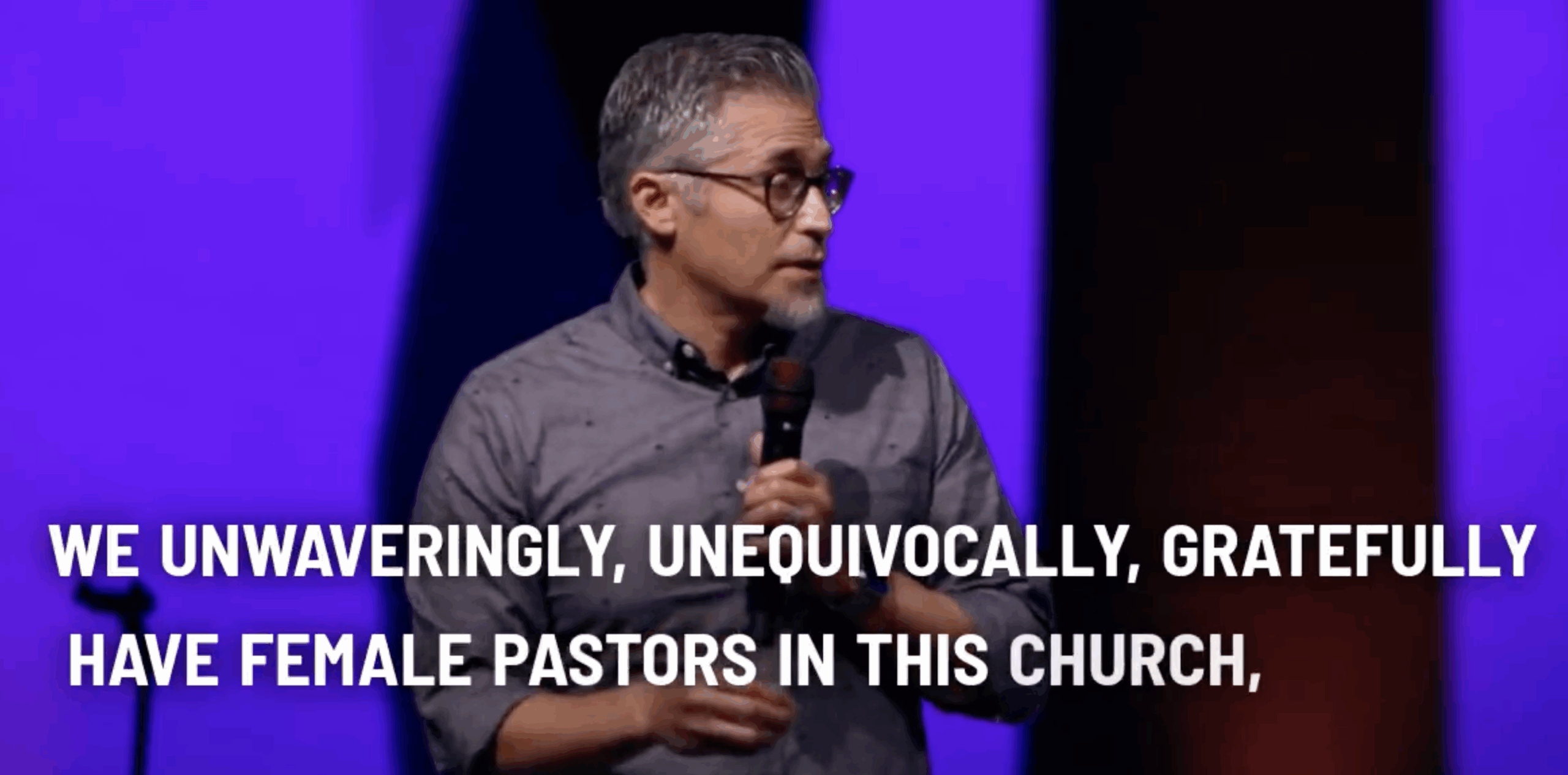
Having had personal conversations with Paredes, I can say that he does not believe that Fielder’s practice or teaching is contradictory to the BF&M 2000, but this is precisely the crux of the problem. If Paredes believed he and Fielder were out of step with the convictions of good-faith partners, then Paredes would be obligated to withdraw.
But since he does not believe this, it is the necessary responsibility of the SBTC and SBC to remove Fielder Church from their respective conventions.
This removal should have occurred earlier this year when the SBTC Credential Committee met to consider Fielder after they had been rightly referred for demonstrably operating outside of the boundaries of the Baptist Faith & Message 2ooo with their commitment to “unwaveringly, unequivocally, and gratefully” having female pastors (or shepherds) in their church.
Unfortunately, as I explained in an article, this semantic escape hatch did not pass muster and should not have been accepted by the SBTC Credentials Committee: “In my view, Fielder Church had made no meaningful change at all. The title remained essentially the same as before the meeting; their stated convictions to affirm female “pastors” were unchanged, and their intention to continue an inconsistent and contrary practice to the BF&M 2000 and the SBTC Constitution remained the same. And yet, the CC failed to act in accordance with the stated expectations and confessional standards of affiliated SBTC churches.”
I also explained the situation in more detail in a podcast interview you can watch here.
Thus, after the SBTC Credentials Committee failed, the three pastors mentioned above made good-faith efforts to lead the gathered SBTC assembly to correct the CC’s mistake and remove Fielder. As mentioned, all three of their motions were rebuffed by SBTC leadership.
Bart Barber (First Baptist Church of Farmersville) has offered an explanation of “what actually happened” during the SBTC annual meeting, and for the most part, he is not wrong. As I understand it, Barber has correctly described the problem with the SBTC Constitution (especially the language of Article IV, Section 4), and he’s rightly noted the impossibility for SBTC messengers to remove any church from the SBTC or to unseat any messengers from an affiliated church. Because of the SBTC constitutional sloppiness, there was no possible way for the messengers at the 2025 SBTC annual meeting to take action to remove Fielder Church or unseat their messengers.
However, if Bart is right, things are worse than we might think. As Jon Whitehead explained, “If Bart is right, SBTC messengers can never remove churches without the consent of their Executive Committee. That is an interpretation that creates a Baptist constitutional crisis, because it creates a Presbyterian, not Baptist, Convention.”
Where I disagree with Barber is not necessarily the facts of what happened at the SBTC annual meeting, but the context — the “chain of events” — and the facts of the case regarding Fielder Church specifically.
Barber blames the “Law Amendment-like motion” passed by SBTC messengers in 2022 for the inability of the SBTC Credentials Committee (CC) to take action to remove Fielder Church during their June 2025 meeting (see my previous article HERE). Barber also says that the Credentials Committee “had no choice” but to take no action against Fielder Church because the CC “found the word ‘Pastor’ nowhere” in Fielder’s staff composition. According to Barber, Fielder’s practice “is contrary to the plain language of The Baptist Faith & Message,” but he also believes that the SBTC (including the CC and the messengers) does not have sufficient language in their Constitution or Confession to remove Fielder from the convention.
On these points, Barber is simply wrong and self-contradictory.
First, the Credentials Committee did find the word “Pastor” in Fielder’s staff composition, including among the titles of several female staff members. I know this because I was a member of the Credentials Committee during the time when the CC was considering a report that Fielder Church employed female pastors. It was only after the CC meeting in June of 2025 that Fielder changed the title “pastor” to “shepherd” for all of their staff members (both males and females). Thus, Barber is wrong.
Second, if Fielder’s present practice is “contrary to the plain language of The Baptist Faith & Message,” as Barber believes, then Fielder does not meet the Affiliation Qualifications for the SBTC. A church can only be affiliated if it “does not engage in or encourage any other practice or conduct deemed to be inconsistent or contrary to the doctrinal statement of the Convention” (Article IV, Section 1).
Therefore, Barber is either wrong in his assessment of Fielder’s practice or wrong in his understanding of the qualifications for affiliated churches. Thus, he is self-contradictory.
Third, the reason behind the SBTC’s adoption of the “Law Amendment-like motion” in 2022 was a previously implemented interpretation of the word “pastor” in the BF&M 2000 by the Executive Board of the SBTC. This interpretation was not public, but it was given to the Credentials Committee for the purpose of adjudicating questions about female pastors in SBTC churches. Until 2022, the CC was instructed by the Executive Board to interpret “pastors” as “senior pastors.” Therefore, the adopted motion was an expansion of this narrower interpretation, addressing not only senior pastors but “any role designated by the noun ‘pastor’” (i.e., children’s pastor, groups pastor, or any other kind of pastor).
Barber is correct when he says, “Bodies are governed by the words we adopt, not by the intentions we had when we adopted them.” However, any Bible interpreter knows that context is king in interpretive work. The context of the messenger-affirmed interpretation of the word “pastor” in the BF&M 2000 clearly indicates that “any role designated by the noun ‘pastor’” was not a limiting or narrowing parameter but an expansive one. Surely Barber and others would not think an SBTC church consistent with the BF&M 2000 if they affirmed and/or employed a female as a “Senior Shepherd,” but this is where such logic leads (as Ben Wright has noted HERE).
Thus, context and authorial intent are relevant, and the words adopted have meaning that Barber refuses to admit.
Whatever misunderstandings there may be on social media, it is easy to see why there is frustration among those demanding consistency on this critical issue.
Either Southern Baptists are complementarian, or we are not. Either we will associate and cooperate with churches that affirm female pastors, or we will not. And no amount of “appeals to unity” or hiding behind policies and procedures to avoid hard decisions will change this. We have two diametrically opposed options before us: confessionalism or liberalism.
And in short order, we will learn what will become of the SBTC and the SBC if we refuse to take the right path at this crossroads. History will show that some of us were trying to steer these institutions toward biblical faithfulness and true unity. An honest assessment of the present reality can see that this is what is happening.
But if those who want unity at the expense of doctrine and confessionalism have their way, then they will reap a harvest of fracture, frailty, and failure.
Share This Story