
Chase Davis puts into words what any man with eyes and a chest can see: the evangelical church has become disastrously feminized
I was first drawn to Chase Davis’s (MDiv, ThM, Denver Seminary) new book by its blood-stained cover depicting Saint George the Dragon Slayer, a Christian knight who confronted a dragon terrorizing a town that demanded human sacrifice.
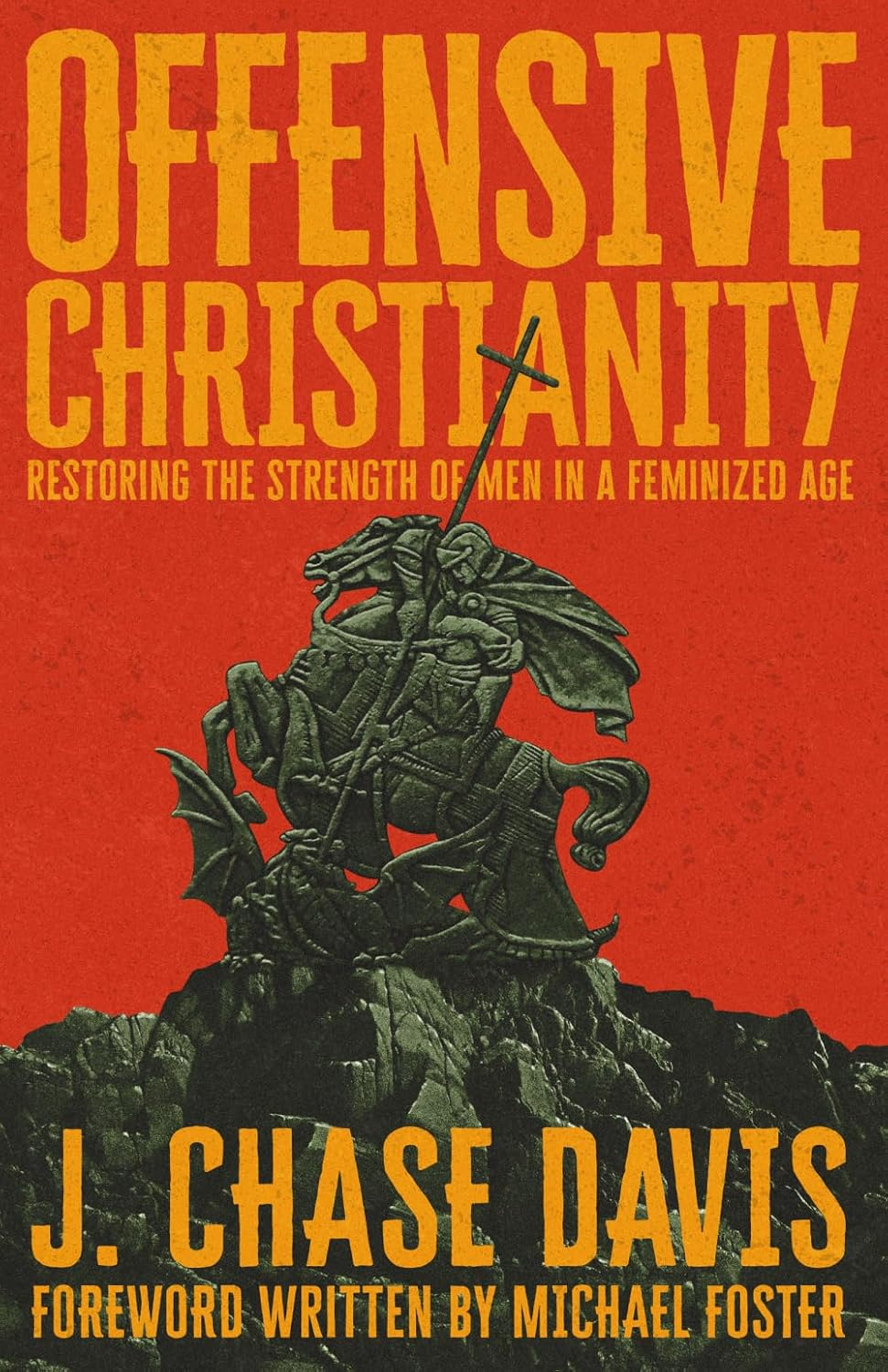
Saint George is legendarily remembered for slaying the dragon and making the sign of the cross, which led the townspeople to embrace Christianity, as it was boldly embodied in Saint George. What might be easily overlooked is a perfect picture that encapsulates the heart of this book, embodying what man is called to do and be.
Offensive Christianity (a wonderful play on words) strives to expand upon this thesis: “Christian men, stripped of their God-given power by a culture that reduces manhood to ideas and demands endless empathy, must embrace an offensive Christianity that boldly asserts authority and action over passive rebellion. Men, particularly Christian men, have become emasculated by considering their responsibilities solely in immaterial terms” (pg. 5).
While this is Davis’s Founders Press debut, his writings have already emerged in a variety of places, from The American Reformer, The Federalist, Mere Orthodoxy, as well as his first book, Trinitarian Formation: A Theology of Discipleship in Light of the Father, Son, and Holy Spirit, and his ever-growing Substack.
Structure
To meet his intended end, Davis structures Offensive Christianity very simply around diagnosis, formation, and action. After a foreword and an introduction titled “The Crisis,” the book divides into two main sections:
- Section 1: “Built for Glory.” Establishes a biblical vision of manhood through three chapters: “Flesh and Blood,” “Men Without Chests,” and “Meek Not Weak.”
- Section 2: “Get to Work.” Moves from principles to practice with “Do Your Job,” “Find a Phalanx,” and “Make War.”
- He closes with “Go on Offense,” a conclusion that gathers the book’s argument into a call to action.
Chapter Summaries
Following an absolutely stellar foreword by Michael Foster, author of It’s Good to Be a Man: Handbook for Godly Masculinity, the book takes the following shape over six chapters:
Chapter 1: Flesh and Blood: Davis argues that masculinity is fundamentally embodied. God created men as bodies and souls with distinctive capacities and a God-given orientation toward glory. He critiques forms of modern evangelicalism that minimize bodily and sexual distinctions, thereby weakening a robust vision of manhood, which has its own goal: “A man’s strength is not random; it is mission-oriented” (pg. 15).
Chapter 2: Men Without Chests: This chapter traces the intellectual and cultural genealogy of six major movements that have contributed to male passivity. These include the Enlightenment, Romanticism, Pietism, higher criticism, Nietzscheanism, and modern evangelicalism. His major contention is that these influences gradually helped replace the virtues of courage, strength, and honor with therapeutic “niceness.” What is the collective damage of these movements? A turn from man’s design to where we find “[e]ntire civilizations are being undone by passive men” (pg. 55).
Chapter 3: Meek Not Weak: Turning positively to Scripture, Davis uses the examples of Adam, David, Jesus, and Paul as models of masculine strength. He distinguishes biblical meekness from weakness, arguing that Christian manhood requires strength governed by righteousness rather than the celebration of weakness itself. He writes, “Meekness is not the absence of strength; it is the discipline to wield strength righteously” (pg. 67).
Chapter 4: Do Your Job: Davis moves from definition to duty, arguing that men are created to exercise dominion by protecting, providing, defending, and building, drawing from the biblical imagery of the sword and trowel found in Nehemiah’s task to rebuild the walls around Jerusalem and simultaneously defend it (Nehemiah 4:18). “We need men who are capable of both building and defending” (pg. 86). He applies these responsibilities to the home, church, and society, insisting that physical strength and assertiveness are tools to be disciplined and used for good.
Chapter 5: Find a Phalanx: Davis emphasizes the necessity of male friendship, brotherhood, and male institutions. He advocates recovering male-only spaces, masculine culture, honor, and churches that form men through shared loyalty and responsibility rather than treating them primarily through a therapeutic framework. Harkening back to his earlier thesis that men are made for glory, the phalanx is an instrumental cog to meet that end: “Men need to find a cohort, a phalanx, of other men who are pursuing glory” (pg. 120).
Chapter 6: Make War: Davis presents Christian manhood as inherently martial: men must make war against sin, endure hardship, accept risk, and become comfortable with necessary (yes, necessary!) conflict. He argues that resilience is developed through struggle rather than through avoiding failure, rejection, or opposition. The solution, in many ways, is simple, though not simplistic: if men are to be aroused from their reclusive, passive slumber, they must be active and go on the offense: “[o]ffensive Christianity requires that men be active” (pg. 138).
Book Strengths
Where Davis’s book excels can be distilled into the following four areas.
- An accurate cultural diagnosis. Davis identifies a pervasive problem within both the broader culture and contemporary evangelicalism: the weakening of distinctly masculine virtues and responsibilities. We live in an era where we are constantly told women can do the same things as men, men must be silent, and that masculinity is inherently toxic. But Davis rightly sees man as he was created to be through the lens of Scripture, which is not a neutered, mirrored image of woman (nor is the reverse true), but the embodied, strong, agent with a telos, who is oriented toward glory.
- Concrete and constructive solutions. As the saying goes, “You can’t beat something with nothing.” Davis goes beyond the problem and offers numerous practical strategies for recovering masculine strength, responsibility, courage, brotherhood, and discipline before the problem becomes even more deeply entrenched. I found his chapter on “Find Your Phalanx” particularly compelling. As someone who has put his feet both in a deeply masculine world of the military and collegiate wrestling, to then be splashed by the cold water of feminization in the academy, I can recall the sweet days of brotherhood and found myself both yearning for and filled with a resolve to see such bonds of brotherhood rekindled in the church, once again.
- A willingness to critique evangelicals’ sacred cows. Not only do the cultural diagnosis and solution land strongly, but Davis is also willing to name and critique influential figures who are often treated as effectively “off-limits” within the broader evangelical world. This plague of living in the fear of man has no place in Christianity yet pervades much of the “Big Eva” space where association makes one guilty or untouchable. Yet his criticisms are grounded in the historical and public record rather than personal animus, and he writes without unnecessary bitterness or rancor. Some of these include Tim Keller, Ray Ortland, John Piper, and Jen Wilkin. The common thread? Perhaps it is The Gospel Coalition, which, at its headwaters, was once staunchly confessionally complementarian, but is now incredibly feminized and caters not to young men nor to confessional fidelity, but to giving the stage over to women. This single thread is easy to trace and helps unravel how feminization has intertwined itself with pietism and niceness and is leaving behind it a Christianity that is winsome but without courage and nuanced to the point of impotence.
- A courageous and emboldening tone. The book practices what it preaches. Davis writes with conviction and courage, and the cumulative effect is not merely informative but exhortational, as he seeks to embolden Christian men to embrace their agency, endure opposition, and be men of action.
Protentional Drawbacks
If the reader is looking for a full exegetical treatment of every assertion and a peer-reviewed defense of every observation, they will be sorely disappointed. Davis writes in a manner that is akin to C.S. Lewis, where it wasn’t as necessary to “show his work” because the light of nature was agreed upon so readily.
Those seeking to dismiss Davis’s work will likely press upon this point, but then this present volume would have failed in its brevity, accessibility, and in what any man who has eyes and an aching chest can see: that the church has become feminized. If we don’t want to become like England where Saint George will dissipate into a myth about toxic masculinity, then the solution Davis offers is that Christianity must go forward by reaching back to what it once was and, at bottom, truly is: offensive.
Conclusion and Recommendation
As I concluded this book, I found myself arguing with my own quibbles. I suppose if there is anything that I left frustrated about, it is that I simply wanted more. Those who wish to avoid the implications of his thesis will do so on the grounds that “it lacks nuance or qualifications,” and will miss the forest for the trees while splitting hairs; meanwhile, the diagnosis remains correctly stated and labeled. Davis’s willingness to name a few of the usual suspects could have been bolstered a hundred times over. But too much focus on those who have contributed to the problem would have left little room for the solution.
I not only recommend Offensive Christianity but have already done so and desire to use its diagnosis, principles, and suggestions to rally and strengthen the men in my own church. In our own square inch of space, we will get to work and go on the offensive to recover our strength, responsibility, brotherhood, beauty, agency, and a Christianity willing to act rather than merely react.
Share This Story